
What Happens to the Body When the Sympathetic Nervous System Stays On Too Long?
The sympathetic nervous system is not the enemy.
It is one of the most intelligent survival systems in human biology.
Its purpose is simple and essential: to protect you in moments of danger or demand.
However, problems arise when this system remains activated for longer than it was biologically designed for.
The Sympathetic Nervous System: A Short-Term Survival System
The sympathetic nervous system prepares the body for action.
It is often called the fight-or-flight response.
When activated, it:
Increases heart rate and blood pressure
Redirects blood to muscles and the brain
Releases stress hormones (adrenaline and cortisol)
Sharpens focus and reaction speed
Temporarily suppresses digestion, immunity, and repair
This response is highly effective in short bursts.
It was designed to help humans escape danger, respond to threat, or meet brief physical demands.
Once the challenge passes, the nervous system is meant to return to balance.
Modern Life: A Biological Mismatch
In modern life, many stressors are:
Psychological rather than physical
Continuous rather than short-lived
Inescapable rather than resolvable
Work pressure, emotional stress, trauma, financial strain, digital overload, and unresolved life demands can keep the sympathetic nervous system activated for months or years at a time.
This is where biology begins to struggle.
What Happens When the Sympathetic State Becomes Chronic
When the body stays in sympathetic activation beyond its natural design, it must continually divert resources away from long-term health in order to maintain survival readiness.
Over time, this leads to system-wide effects.
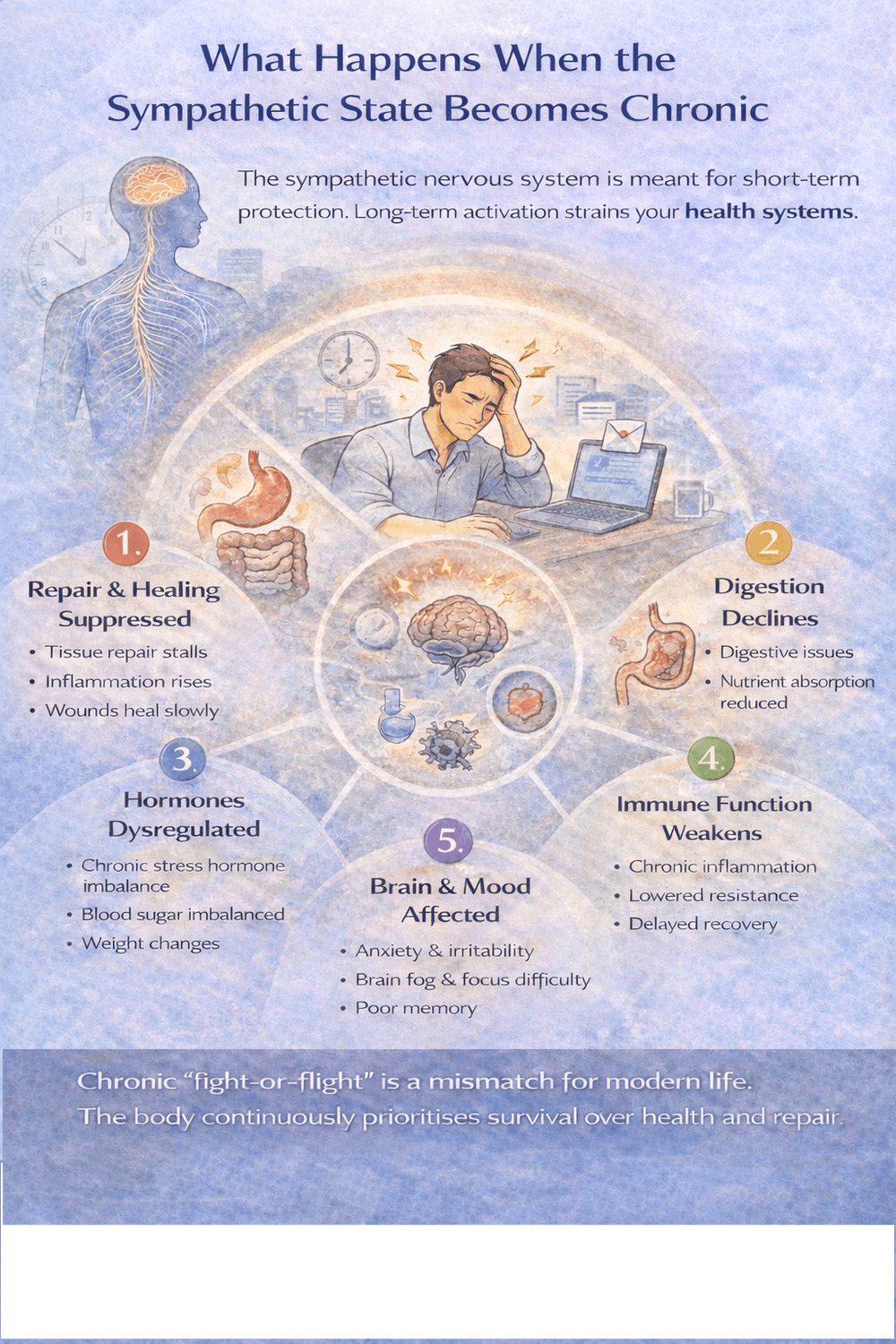
1. Repair and Healing Are Suppressed
In sympathetic mode:
Tissue repair slows
Inflammation increases
Wound healing is delayed
Recovery from illness takes longer
The body prioritises survival over restoration.
Healing becomes secondary.
2. Digestion and Nutrient Absorption Decline
Chronic sympathetic activation:
Reduces digestive enzyme secretion
Slows gut motility
Alters the gut microbiome
Impairs nutrient absorption
This can contribute to bloating, reflux, IBS-type symptoms, food sensitivities, and fatigue—even with a healthy diet.
3. Hormonal Systems Become Dysregulated
Prolonged stress affects:
Cortisol rhythms
Insulin sensitivity
Thyroid function
Sex hormones
Sleep-wake cycles
Over time, this may present as exhaustion, poor sleep, weight changes, mood instability, or reduced resilience to stress.
4. Immune Function Weakens
Short-term stress can sharpen immunity.
Chronic stress does the opposite.
Long-term sympathetic dominance:
Suppresses immune cell activity
Increases chronic inflammation
Reduces resistance to infections
Slows recovery from illness
The immune system cannot fully regenerate without adequate parasympathetic time.
5. Pain Sensitivity and Muscle Tension Increase
When the body remains on high alert:
Muscles stay contracted
Pain thresholds lower
Old injuries may re-activate
Tension patterns become chronic
This can contribute to persistent pain, headaches, jaw tension, and musculoskeletal issues.
6. Brain Function and Emotional Regulation Are Affected
Chronic sympathetic activation impacts the brain by:
Reducing prefrontal cortex function (reasoning, planning, clarity)
Increasing emotional reactivity
Impairing memory and concentration
Increasing anxiety and overwhelm
The brain becomes efficient at scanning for threat—but less capable of creativity, empathy, and reflection.
The Core Issue: The Body Never Gets the Signal That It Is Safe
The most important thing to understand is this:
The body does not break down because it is weak.
It breaks down because it never receives enough signals of safety.
Without safety:
The parasympathetic nervous system cannot engage
Repair and regulation remain incomplete
Symptoms persist as adaptive signals
The Path Back to Balance
Restoring health is not about eliminating stress entirely.
It is about restoring nervous system flexibility—the ability to move out of sympathetic activation and return to regulation.
This requires:
Time spent in parasympathetic states
Supportive environments
Non-doing and true rest
Therapeutic approaches that work with the nervous system, not against it
When the nervous system can settle, the body regains access to its natural repair processes.
In Summary
The sympathetic nervous system is essential—but not meant to run the body long-term.
When it does:
Healing slows
Systems become strained
Symptoms emerge as intelligent signals
The body asks for regulation, not force
Health is restored not by pushing harder, but by allowing the body to return to balance.

Cocoa Ho
The Representative for The Body
Stay informed with valuable health and wellness tips delivered straight to your inbox.

Valuable Health Insights,
Expert Nervous System
Guidance and Resources


Stay informed with updates, workshops, special offers, valuable health and wellness tips delivered straight to your inbox.
Created with © Cocoa CranioSacral Therapy & Natural Healing Science